WELCOME TO THIS GREAT EDUCATIONAL BLOG

Welcome to my Pre-Nursing Exam Prep blog. I hope it will help you prepare very well for the Pre-NLN entrance exam, popularly known as the PAX exam. This is one of the entrance exams required by some schools for those who want to pursue careers in the nursing field in the USA. I will attempt to break down the review materials into manageable parts so that you can systematically and efficiently prepare for the test with less stress. I will guide you to prepare for the entire content of the test. Hopefully, you will be able to pass after going through these series.


BEST OF LUCK!


To support this blog you can make a donation by clicking on the link below:
Become a Patron!

A 12-DAY APPROACH TO ACE THE EXAM

SCIENCE REVIEWThe topics that are generally covered in the test have been grouped into twelve instructional modules below. You will be tested only on the basic concepts of physics, chemistry and biology. Click on science topics and select any of the topics listed in the module to review.

Lesson 1:

Basic structure of atom

Types of tissues

Lesson 2:

Movement of substances across the cell membrane

Acids and bases, pH scale

Carbohydrates, proteins, lipids and nucleic acids

Lesson 3:

Basic structure of the eye

Basic structure of the ear

Nervous system

Lesson 4:

Circulatory system

Introduction to mechanics (motion/forces)

Electrical circuits

Lesson 5:

Balancing chemical equations and writing formulas

Essentials of photosynthesis and respiration

Classifying organic compounds

Magnetism

Electromagnetism

Lesson 6:

Interpretation of graphs and pictograms

Analyzing and making conclusions from experiments

Data analysis

Lesson 7:

Endocrine system

Digestive system

Genitourinary system

Lesson 8:

Reproduction in mammals

Basic parts of a flower

Reproduction in plants (the process of pollination

Genetics

Lesson 9:

Modes of heat transfer

Calculating heat energies and phase diagrams

Temperature conversions (Kelvin, Celsius, Fahrenheit)

Lesson 10:

Gas laws (Boyle, Charles, Gay-Lussac)

Types of energy (Potential, kinetic, etc…..)

Chemical bonds, equilibrium and equilibrium constants

Mixtures, types of solutions, solubility

Lesson 11:

Concepts of the food pyramid, food web and food chain

Light (diffraction, refraction, reflection, dispersion)

Basic concepts on waves

Sound waves

Catalyst and enzymes

Lesson 12:

Symbiosis

Ecology

The Electroscope

Radioactivity and half-life Tropism

Tropism

Wednesday, April 9, 2014

QUESTIONS FOR THE DAY

1. What is the pulmonary circulation?

2. What is the systemic circulation?

3. What will happen when the tricuspid valves fail to function well?

4. What will happen when the bicuspid valves fail to function properly?

5. What will happen when the left ventricle fails to pump blood into the aorta?


OVERVIEW OF THE CARDIOVASCULAR (CIRCULATORY) SYSTEM

We will look at the basic concept and structure of the cardiovascular system today. You only need to know the basic structure of the general circulation to pass the test. We will begin by looking at the structure of the heart.

Diagram of the cardiovascular system.

The heart consists of four chambers:
1. Left ventricle
2. Left atrium
3. Right ventricle
4. Right atrium

The right side of the heart carries deoxygenated blood while the left side carries oxygenated blood.

Deoxygenated blood return to the right atrium from lower parts of the body via the inferior vena cava and from the upper part via the superior vena cava.

The right ventricle pumps deoxygenated blood to the lung via the pulmonary artery. Note that all arteries carry deoxygenated blood except the pulmonary artery.

Oxygenated blood return to the left atrium from the lung via the pulmonary vein. Note that all vein carry deoxygenated blood except the pulmonary vein.

The left ventricle pumps the oxygenated blood to the other parts of the body via the aorta (the largest artery in the body)

There are valves between the atria and ventricles. The one on the left is called the mitral valve (bicuspid valve) and the right one is called the tricuspid valve. These valves prevent the back flow of blood.

Tuesday, April 8, 2014

CHEMICAL BONDS

Basic concept on chemical bonds
1. Ionic bond: The bond formed when one atom looses electrons and the other accepts  
      them. It is formed when a metal bonds to a non-metal, example: NaCl
Original electronic configuration : Na  2:8:1                      Cl    2:8:7

Sodium loses one electron from its outermost shell (valence shell)  to become   Na+ 2:8                   and  chlorine gains this electron to become Cl-   2:8:8   
 Hence  Na+Cl-    -----------> NaCl

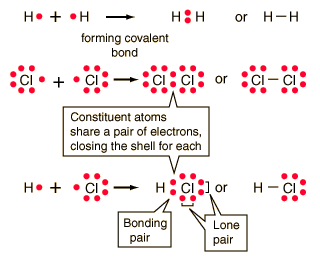
2. Covalent bond: This is the bond formed through the sharing of electrons. It is formed
    when non-metal bond to each other. Examples: H2, Cl2, HCl
Water is neither purely ionic nor purely covalent because the electrons are not shared equally. The more electronegative element, oxygen, tends to pull the shared electrons from the less electronegative (electropositive), hydrogen atom. One end, or pole, of the molecule has a partial positive charge (+), and the other end has a partial negative charge (-).Water is best described as a polar compound.

As a rule, when the difference between the electronegativities of two elements is less than 1.2, we assume that the bond between atoms of these elements is covalent. When the difference is larger than 1.8, the bond is assumed to be ionic. Compounds for which the electronegativity difference is between about 1.2 and 1.8 are best described as polar, or polar covalent.

Hydrogen bonding: When hydrogen atoms are joined in a polar covalent bond with a small atom of high electronegativity such as O, F or N, the partial positive charge on the hydrogen is highly concentrated because of its small size. If the hydrogen is close to another oxygen, fluorine or nitrogen in another molecule, then there is a force of attraction termed a dipole-dipole interaction. This attraction is known as hydrogen bonding.

Hydrogen bonding has a very important effect on the properties of water and ice. Hydrogen bonding is also very important in proteins and nucleic acids and therefore in life processes. 

Monday, April 7, 2014

THE REFLEX ARC

When a person steps on a sharp object, the response is immediate. It does not initially involve the brain. This involves the reflex arc which occurs in the spinal cord. The reflex arc consists of the sensory neuron (also called the afferent neuron), which transmits the stimuli of pain to the spinal cord. Within the spinal cord, it relays with the interneuron which decodes the message and sends the response to the muscles of the limbs via the motor neuron (also called efferent neuron) to bring about an action.

Diagram showing the reflex arc.

Thursday, April 3, 2014

BE INSPIRATION


Today, we will take a little break from the academics and to enjoy this inspirational message. Believe in your ability and capabilities to brace the storms of life to soar high up in the skies beyond reasonable comprehension.  It is fact that God has equipped you with the necessary tools so that you can do all things if you apply yourself diligently it. We all have the potential to succeed if we look beyond our short-falls, weaknesses, disabilities, challenges, and whatever our socioeconomic backgrounds may be. 

As in the poem by Longfellow:

 The heights by great men, reached and kept;
 Were not attained by sudden flights;
 But they, while their companions slept,
 Were toiling upward in the night.

It takes hard work to make it into a  nursing school and to sail through it to the end. Working hard will not break your bones! Apply yourself to your set goals and in the end, you will succeed.

Keep learning and the best of luck in all your endeavors!

STRUCTURE OF THE HUMAN BRAIN

The brain is very complex but we will discuss the basic concepts needed for the exam.

1. Cerebrum: This forms the bulk of the brain and it is responsible for the intellectual functions such as thinking, learning, motor skills, sensory functions, personality, etc.
2. Cerebellum: This is the center that helps with balancing of the body during various movements.
3. Medulla oblongata: This is the cardio-respiratory center. It controls the rate of the heart and also the rate of respiration. It is closely related to first cervical bone which has the protrusion called the dens. When the dens fractures during a whiplash injury, it can compress on the medulla and then the heart and respiratory system will fail to function.
4. Thalamus: This relays motor and sensory signals to the cerebral cortex. It regulates consciousness, sleep, and alertness. 
5. Hypothalamus: The hypothalamus is responsible for certain metabolic processes such as the synthesis and secretion of certain neurohormones (often called releasing hormones or hypothalamic hormones). It also plays a role in autonomic nervous system by controling body temperaturehunger, important aspects of parenting and attachment behaviors, thirst, fatigue, sleep, and circadian rhythms.
6. Pons: This acts as a relay station between the cerebrum and the cerebellum. It is also plays a role in sleep and dreaming.


Wednesday, April 2, 2014

THE EAR STRUCTURE

Click here to look at the Diagram of the human ear

There are three parts of the human ear. We will not deal with the fine details here. Just know the basic things.
1. Outer ear: This extends from the pinna (ear lobe) to the tympanic membrane/tympanum (ear drum). It has the auditory canal or meatus. This conducts sound to the middle ear.
2. Middle ear: The middle ear house the three bony structure called incus (anvil), malleus (hammer), and stapes (stirrup). They vibrate to transmit the sound waves to the inner ear.
3. Inner ear: The houses the cochlear, semi-circular canals, and the vestibule. There are three semi-circular canals arranged at right angles to each other (superior, lateral, and posterior semi-circular canals)

Important to note: The cochlear is the organ for hearing. The semi-circular canals are the organ for balancing.

Think about what will happen when the cochlear or semi-circular canal is damage.